
Fields, Rivers, Mountains
Essay by Macaulay Woods, November 11, 2026
The Connecticut River runs the length of Western Massachusetts, carrying snowmelt, sediment, the memory of ten thousand years of Abenaki and Nipmuck life along its banks in that valley. Salmon ran it in numbers that are almost unimaginable now. ¹ The Indigenous people who fished it, traveled it, and built their communities along its tributaries called it Quinetucket, “the long tidal river.” It was the spine of an ancient world. A 410-mile river that reaches from the border of Canada to Long Island Sound.
The Fuller family came to this continent on the Mayflower in 1620, fleeing religious persecution in England. Shortly after arriving in Provincetown Harbor, several of my 12th-great-grandfathers signed the Mayflower Compact. In doing so, they became participants in a colonial expansionist project that would ultimately annihilate the existing Indigenous population; historians estimate that their numbers fell from roughly one hundred million to ten million. ²
People who commission to have history books written often claim that many excess Indigenous deaths have been attributed to disease alone, as though disease arrives without cause. But starvation, displacement, trauma, contaminated water, and the destruction of civilian infrastructure are not neutral conditions. They are manufactured ones. The mechanism of ethnic cleansing is sadly familiar. Settler colonial violence introduces the conditions that produce mass death and supplement the ongoing collateral punishment of the civilians happening now in Gaza.
Lancet researchers have estimated, extrapolating from available data, that between 186,000³ and 680,000⁴ Palestinians have died in Gaza since 2023. More than half of those killed were children under eighteen. For every violent death, there are an estimated three indirect deaths caused by the imposed conditions of mass deprivation.⁹ This apparatus is not new.⁵ History books often obscure these inconvenient truths.
An accurate mortality count in Gaza does not currently exist due to the conditions of war and closed borders. Unrelenting bombing has left widespread destruction and buried remains of thousands of people beneath piles of concrete rubble that scatter the flattened landscape. The people who are officially tasked to tally the dead, the casualty recorders, are not able to do so with any kind of accuracy.
The wild and catastrophic use of bombs that liquefy and evaporate human remains are today’s weapons of choice. The dead are not able to be collected and buried with any kind of dignity. Their bloodlines lost, their souls are cast to the wind.
Activists are criticized and trolled online for speaking out about the ongoing brutal war on the people of Gaza, after the horrific events that transpired on October 7, 2023. I do not condone the violence that occurred on that day. Killing is wrong. We know this as an absolute. Killing in self-defense is sometimes more accepted by society if people are being oppressed. Society generally believes that people maintain the right to defend themselves and their loved ones if they are under imminent threat. That concept is also openly accepted as an individual’s right to stand their ground. Both sides can certainly maintain that argument but one side is armed with an endless supply of American bombs.
What occurred on October 7, 2023, is still unclear. We know that around 1,500 people lost their lives on that day. Many were young Jewish people attending a music festival; other Jewish families were killed in their homes. IDF members were abducted and taken over the border and kept as hostages for many months in inhumane conditions. They were used as bargaining chips in a conflict that reaches back to 1948 between two entities that deeply hate each other.
After October 7th, Palestinians were subsequently rounded up and executed by the thousands. As such, we have no reliable account of how many individuals have met their deaths in Gaza. The bombing continues, the hunger continues. The flooding continues to break away the minimal shelter that the civilians have to protect themselves. The lack of medicine and adequate civil systems continues to plague the Strip.
The Military Industrial Complex grinds through the region like a juggernaut. Our national budget continues to spend billions each year on War instead of educating and providing affordable housing to our people.
But something unexpected occurred on November 3, 2026; our nation came out in droves to send a message of change. This was an epic turnout across our USA. Americans on both sides of the political spectrum oppose this war. Ninety million Americans declined to vote in 2024; many abstained to register their dissent. The Midterms were neither a Democrat versus Republicans referendum, nor a Team Red or Team Blue ideology fest.
This was about change.
Americans would like to return to a society that maintains a strong social safety net, one that espouses freedom of speech, human decency, and the pursuit of happiness. Americans came out to vote because our Constitution has been greatly battered by both parties and by Citizens United. Seeing the whole map of our nation turn blue restored my faith, not in politicians and their rhetoric and false promises—but in our people.
Our people have a heart. We saw that on Midterm Election Day. We cast aside our differences and ideological arguments for one day to say- something has to change here. Democrats will be greatly remiss if they ignore that message. Because, next time, it may not be the ballot box where we take our stand. Politics and geopolitics cannot continue to blindly barrel down the highway that we are currently on. One that treats our most vulnerable with abandon, one that puts the stock market above human rights and animal rights. Americans on both sides want change and action. We do not want to be divided along ideological lines by fake populists. We do not want to be lied to and manipulated by the narcissists in power who use deception as a weapon against the populace.
Americans loved FDR and JFK because they treated us as one team. We harbor a long history of inequity from the Native Americans who were slaughtered by the millions to the African people who were trafficked here four hundred years ago to the Japanese citizens stripped of their property and held in detention. America has bad karma on this land and we need to heal ourselves and make ourselves whole. We need to acknowledge our bloody colonial history as well as praise and feel proud of our good and decent ancestors who fought in the many wars that have occurred both on our land and overseas.
Many of my ancestors are buried in and around the Quabbin in Western Massachusetts. My English family were mostly farmers—some soldiers, doctors, and reverends; but to my knowledge, not governors and architects of policy. They were present during the ethnic cleansing of the Indigenous people in Massachusetts and they benefited by “settling” the land that had been someone else’s home for several thousand years. They were colonists or colonizers, depending on the point of view, initially running for their lives in search of freedom, and in doing so, they disrupted a thriving civilization of millions of Indigenous people.
American children in history class are not taught about the scores of Indigenous people who were slaughtered and displaced by colonial settlers across our nation. We learned the propagandized version, the Cowboys vs. Indians version; we heard the frontier lore of the “savage” Indians scalping and raping Pioneer women with long blonde hair. No one taught us about the European bounty hunters who were paid for turning in scalps of Native American women and men across North America. It is the mechanism of propaganda and its intended metric—dehumanization—that allows genocide to march forward. Propaganda by design compels the guilty or enraged American voter to stay silent as children are mass slaughtered. ⁶
Today is Veterans Day, 2026.
My 5th-great-grandfather Ichabod Wood fought in the Revolutionary War and then moved his family from Middleborough, Massachusetts to the Swift River Valley in Enfield, Massachusetts, sometime in the 1700s. The land where the Nipmuc and Abenaki had lived for thousands of years. He had a son and named him Ichabod Jr. They both married women named Lucy.
His son Ira S. Woods and daughter-in-law Mary Ball Montgomery lived in Enfield, Massachusetts on land the Connecticut River fed and flooded each spring. The river was life. The water fed that life. Enfield was a bustling town that boasted fertile farmland, clear water, and New England-Acadian forests. Our family farmed the rich land. They had children on it. They buried their dead in it, same as the Indigenous inhabitants had for ten thousand years before them.
But it wasn’t their land. It had been taken at gunpoint. Families were killed; children were slaughtered alongside their mothers and fathers and grandmothers. The people who had lived there for thousands of years were either killed, sold off to slavery in the Caribbean, or died of starvation and disease.⁷
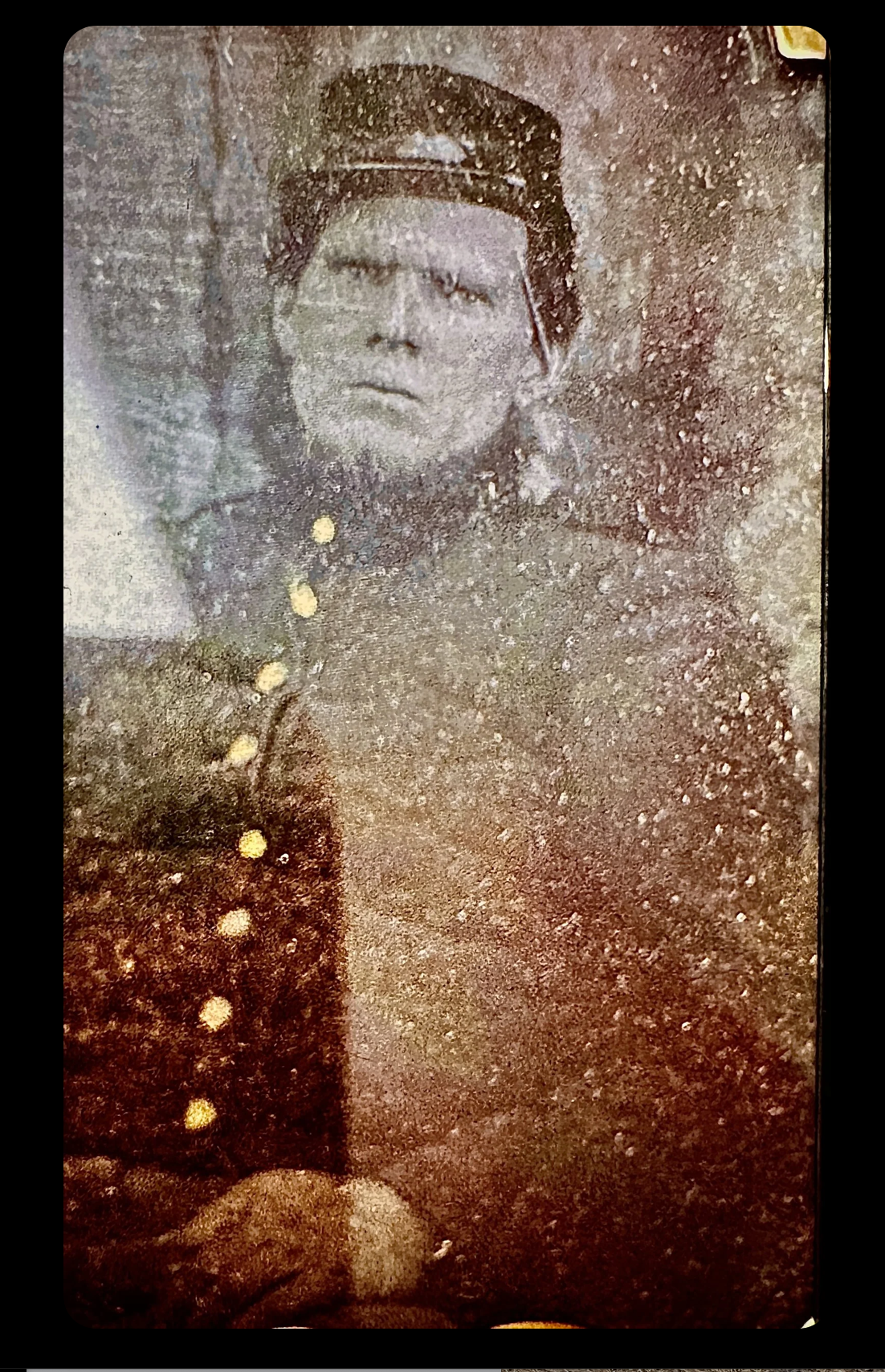
My 2nd great-grandfather Henry Woods, Mary and Ira’s son, was born in Enfield, Massachusetts, in 1846. He fought in the Civil War, Company K, 21st Massachusetts Infantry Regiment, which saw action in Roanoke Island & New Bern, Second Bull Run & Chantilly, South Mountain & Antietam, and Fredericksburg. Enfield was one of the four towns that sat in the Swift River Valley and was eventually taken by eminent domain and later drowned by the state.
Henry was one of the few who came home from the War. He became a carpenter. There is a photograph of Henry in his later years, standing on a street in Enfield with his Jack Russell terrier in a wheelbarrow. One of my grandmothers wrote his name in blue ink in the corner of the photo. The houses behind him, the telephone poles, the November trees stripped of leaves are all still underwater now. Henry died in 1931 before his home was flooded in 1938.
On April 27, 1938, the towns of Enfield, Dana, Prescott, and Greenwich were disincorporated, and more than 2,000 people turned out for a Farewell Ball that lasted until 2 AM. The flooding began in 1939 and took seven years to fill the now hollowed out native valley.
In 1946, the Commonwealth of Massachusetts completed the Quabbin Reservoir project that still provides drinking water to the city of Boston. The four drowned towns are now lost underwater. ⁸ The towns moved headstones of the residents to the Quabbin Park Cemetery with the other English and European dead. The Indigenous burial grounds along the river were likely not moved before the flooding occurred.
My great-grandfather Walter and his wife Grace Woods left the valley and settled in Springfield, MA where Walter opened a plumbing company at 25 years old. Grace contracted tuberculosis at some point, and Walter moved the family up Wilbraham Mountain so that she could heal. They had five children.
My grandmother Edna Charlotte Woods was born in 1918, the year the first World War ended. She graduated from high school during the Great Depression. Edna learned to play violin and performed with the Springfield Symphony. She played violin her whole life until she went blind in her nineties and couldn’t read the sheet music anymore.
She took me to Springfield Symphony concerts. We also saw Fantasia together at a movie theater, where I first noticed how abstract forms danced around the dark room to classical music. Color and shape became cosmos. I fell in love with the movies and the way form, line, color and music collide to create magic.
When my ancestors left Europe and colonized this land now called America, thousands of Indigenous people who had lived in Massachusetts for generations were killed. Some died from direct deaths, gun shot wounds and canon fire. Some of them died from indirect means: disease, dehydration, starvation, trauma, and exposure to the elements. But their real cause of death was genocide due to colonial expansion because there was land and resources to be exploited for a now murky ideology called freedom.
Indigenous civilizations learned through many thousands of years how to exist symbiotically with the land and her animals. Water is the most precious element to sustain life. Yet, we still take it for granted today. Water is now a commodity on the stock market.
As we consider as a society the current debate on the development of data centers and the environmental pollution and water consumption that are offsets of progress, we must stop to ask what we are willing to sacrifice for that progress? The stock market and profit making cannot dictate our course.
Today, the Swift River Valley still lies drowned beneath the Quabbin. Under the water where the four towns were submerged, there are still telephone poles, fieldstones, bare trees, and razed houses. The bones of the Indigenous people who inhabited that valley are still uncounted, just like the bones of the civilians of Gaza who still remain under the rubble.
NOTES
1. Haag, Robert E. 2023. Atlantic Salmon Return to the Connecticut River. EBSCO. https://www.ebsco.com/research-starters/zoology/atlantic-salmon-return-connecticut-river
2. Williams, Charlotte. 2023. 'Estimating Population Loss and the Ongoing Aftermaths of Colonization'. Dispossessions in the Americas. U Penn. https://dia.upenn.edu/en/content/WilliamsC004/
3. Khatib R, McKee M, Yusuf S 2024. Counting the dead in Gaza: difficult but essential. The Lancet; 404, 237-238 https://www.thelancet.com/journals/lancet/article/PIIS0140-6736(24)01169-3/fulltext
4.Hil, Richard and Polya, Gideon. 2025. Skewering History: The Odious Politics of Counting Gaza’s Dead https://arena.org.au/politics-of-counting-gazas-dead/
5.Qureshi Y, Dawas K, Maynard N. 2024. Excess deaths in Gaza. The Lancet Global Health, 12e1395 https://www.thelancet.com/journals/langlo/article/PIIS2214-109X(24)00267-5/fulltext
6. Janelle Smart Fisher. 2025. Rum, Molasses, and Slavery in Boston. The West End Museum. https://thewestendmuseum.org/history/era/new-fields/rum-molasses-and-slavery-in-boston/
7. William S. Kiser. 2025. “The Long Shadow of Indian Scalp Bounties.” Yale University Press. https://yalebooks.yale.edu/2025/03/11/the-long-shadow-of-indian-scalp-bounties/
8. Bourgault, Bethany, 2022. “Lost Towns of the Quabbin Reservoir” Yankee, https://newengland.com/yankee/history/lost-towns-quabbin-reservoir
9. Norwegian Refugee Council. June 2026. Gaza: Israel’s shelter restrictions force nearly a million people to endure summer heat in tents. https://www.nrc.no/news/2026/gaza-israels-shelter-restrictions-force-nearly-a-million-people-to-endure-summer-heat-in-tents
©Macaulay Woods 2026, All rights reserved.
DOWNLOAD
Fields, Rivers, Mountains is a personal essay by Macaulay Woods exploring the intersections of family history, American history, war, and the political landscape of the United States in 2026. Through ancestral memory and historical reflection, Woods examines the complex legacies of land, identity, conflict, and belonging. Free for you.