Art Criticism
Van der Weydens’
St. Luke Painting the Virgin
Essay by Macaulay Woods · 1990
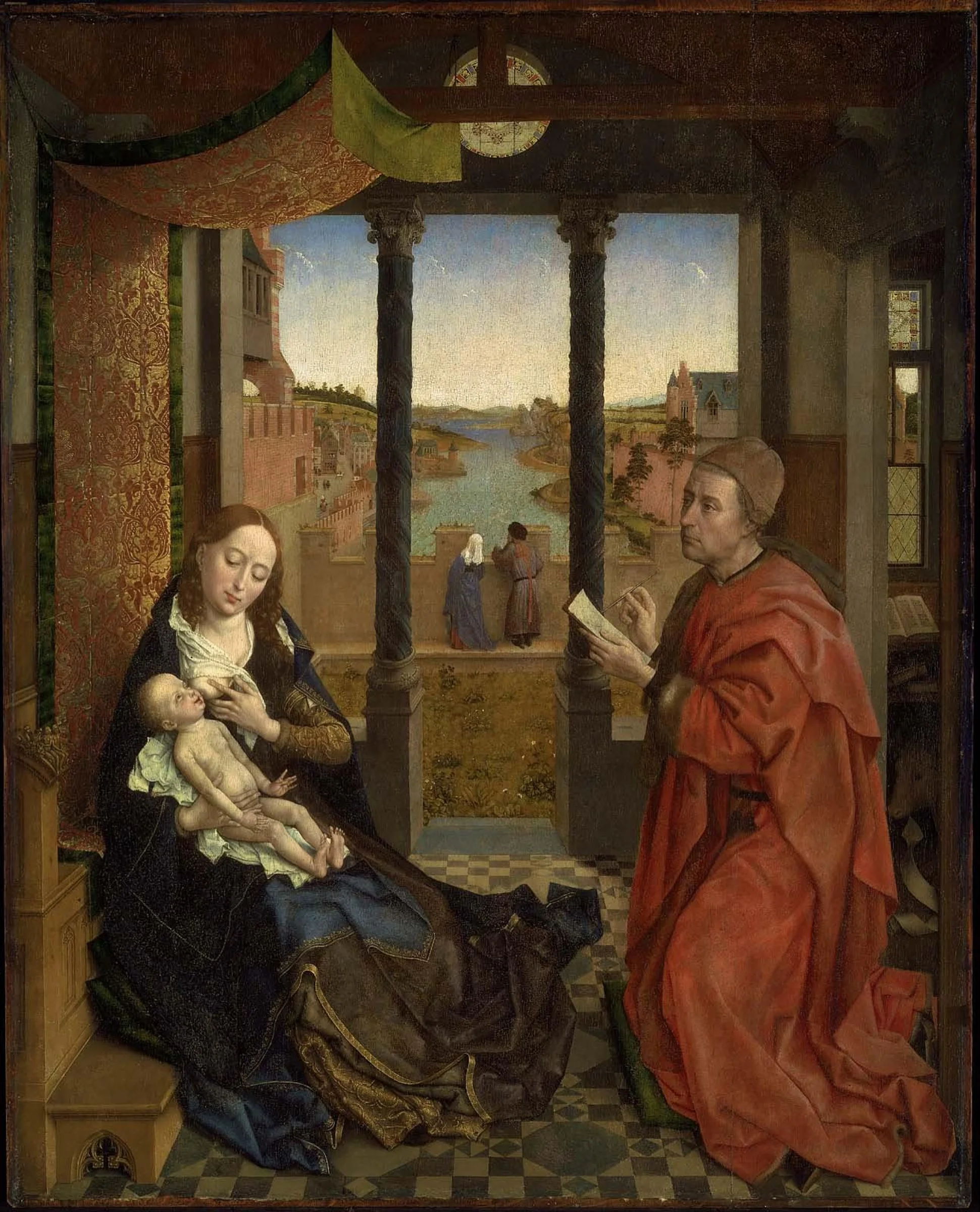
Saint Luke Drawing the Virgin, Rogier van der Weyden
Rogier Van der Weydens’ St. Luke Painting the Virgin daringly invites humanity into the frame with the anointed. Painted between 1435–1440, this 138” x 11” oil and tempera panel hangs in the Boston Museum of Fine Art amidst Christian iconography. The piece expands three planes. A tranquil Madonna sits for St. Luke, who captures the Christ child suckling the supple breast of the Virgin in silver point. In the next plane, a peasant couple admires the winding river valley beneath them, a serene moment in the life of a Flemish village.
Van der Weyden creates spatial illusion by placing the couple on the patio in a diagonal line from the foreground action. Orthogonals lead the eye from the Virgin to the couple relaxing on the stone wall. Painted in recession, all action beyond the foreground subjects are diminished in size according to distance. By employing recession, Van Der Weyden manufactures his desired three dimensional effect. The river winds from the horizon into the foreground, snaking across the geometric tiles between the feet of St Luke and the Virgin. Van der Weydens’ use of curvilinear negative space unites the three planes of the panel.
The serene river runs through the center of the panel. On its’ left bank lies the picturesque Flemish village alive with action. The great cathedral sits alone on the right bank. Van Der Weyden relies upon the religious symbolism with the central placement of the river. The cathartic presence of the water extends into negative space in the vestibule, winding between the Virgin and St Luke.
Van der Weyden unites the three planes in the panel with a theme of peace using various techniques, the artist extends the privacy of the Divine moment using the negative space to extend to the river in the background. The panel has a quiet spirituality.
The painter relies on his application of color to convince the viewer that the panel is indeed realistic, Subdued light radiates from beyond the river valley. Muted reds, greens, blues, and golds decorate the tranquil landscape. Van der Weyden disperses these colors throughout the panel using various intensities in all three planes. The artists’ technique of repeating a trail of similar colors along the orthogonal lines pulls the viewer to each frame of the panel. The Virgin wears a deep blue gown. Along the diagonal line, the peasant woman’s dress is a muted blue, as is the roof of the cathedral. In similar fashion, Van der Weyden paints the Saints’ robe a lovely crimson while a piece of the woman’s dress and the village brickwork along the same orthogonal is also red.
A subtle tension balances the warm and cold contrast of the panel. Stained glass windows illuminate the Virgins’ face with gentle light. The circular stained glass and archway serve as a symbolic halo thus eliminating the redundant use of the golden pie plates viewed in early Christian work. Soft hues play across the hazy river valley and gather in its’ intensity as they fall upon the Madonna. Regal golden embroidery embellishes the Virgins’ gown and the tapestry draped above her head.
Color in the panel reinforces its’ tranquil theme. Van der Weydens’ execution of color and line evoke a holy splendor from the panel. The Virgin, perched upon the bottom step of the throne, leans into the mouth of the Christ child. Both the Virgin and the Saint bend into s-shaped figures. St. Luke balances on one knee while studying the Mother and Child. Twisting Corinthian style columns frame the peasant couple resting against the stone wall while admiring the view. Verticals are created along these columns and with the ornate drapery running up the wall behind the Virgin. Van der Weyden travels the span of the panel with the vertical line, curvilinear and triangular shapes. He groups the figures in pyramid style. The Virgin, the Flemish couple and St Luke form one triangle; while the couple, the cathedral, and the village form yet another symbolic triangle.
The orthogonal lines guide the eye to the Flemish couple who serve as one vanishing point of the panel. Van der Wyden models the figures and drapery with chiaroscuro and refrains from the harsh line. He softly models the Virgin’s flesh with light and dark shades. Her pale breast, hands and rosy face appear natural and inviting. St Lukes’ more solemn rugged face resonates with rich earth tones.
Van der Weyden paints objects in the panel realistically. One believes the weight of the stone columns, the texture of the wooden throne, and the golden embossed tapestry; however the artist’s depiction of the foreground figures still reveal an awkwardness in form.
The Christ child encaged by his rigid oversized torso, sports the body of a young child with the head of an infant. While Van der Leyden renders the gentle face in soft baby flesh, he struggles with the irregular form of the Child and the longish hands of the Madonna who holds Him.
The Christ child appears removed from His mother’s lap due to His rigid posture and the way He gazes up at the ceiling. Similarly, St. Lukes stares off to the left and behind the Virgin and Child. Attention to detail painstakingly rendered by Van der Weyden with an intent to unify the composition is slightly hindered by the unmet gazes of the subjects in the foreground.
Van der Weyden creates a pious moment in time. His inclusion of humanity within the panel signifies a new movement in painting. He ties in daily Flemish life with the Church, rather than separating man from God, he entertains them. The notion of time and continuing space is alluded to by the opening up of the canvas with light and the distant horizon. His expertise at spatial illusion projects the viewer both into the past and the future.
Essay written December 5, 1990, ©Macaulay Woods 2026, All rights reserved.
Notes
Chadwick, Whitney, Women, Art and Society Thames and Hudson, 1990
Herrera, Hayden Frida: A Biography of Frida Kahlo, Fitzhenry and Whiteside, limited, 1983
Lowe, Sarah, Frida Kahlo, Universe, 1991
Mackinley Helm, Modern Mexican Painters, Harper and Brothers, 1968
Petersen, Karen and Wilson, J. J., Women Artists, Harper and Colophon, 1976
White Chapel Art Gallery, Frida Kahlo and Tina Modotti, 1982